Who was Master Mateo?
The sculptor and architect who signed the Portico of Glory in 1188 gives our association its name. This is what we know about him, and what remains a mystery.
At the entrance to Santiago Cathedral there is a name carved in stone. On the lintel of the Portico of Glory, a Latin inscription records that on 1 April 1188 Master Mateo set in place the lintels of the main doors of the church of Saint James, and that he had directed the work on those porticoes “from their foundations”. Few medieval artists left their signature on a work. It is also where our association’s name comes from.
A man we know little about
What we know of Master Mateo is mostly his work. We do not know where he was born, where he learned his craft or when he died. The first reliable document dates from 1168: on 23 February that year, King Ferdinand II of León granted him a lifelong pension of two silver marks a week so that he could devote himself to the cathedral. A privilege like that was only given to a master of established reputation.
From then on, records allow us to follow his work in Compostela for decades, up to the consecration of the cathedral in 1211. His name still appears in documents from the early thirteenth century. After that, his trail goes cold.
The Portico of Glory
Mateo’s task was to complete the cathedral at its western end, where the ground slopes away. To level it, he first built a crypt, known as the Old Cathedral, and on top of it raised the portico and the gallery above. He also designed the canons’ stone choir, which filled much of the central nave. It was dismantled in the early seventeenth century, and some of its pieces can be seen today in the Cathedral Museum.
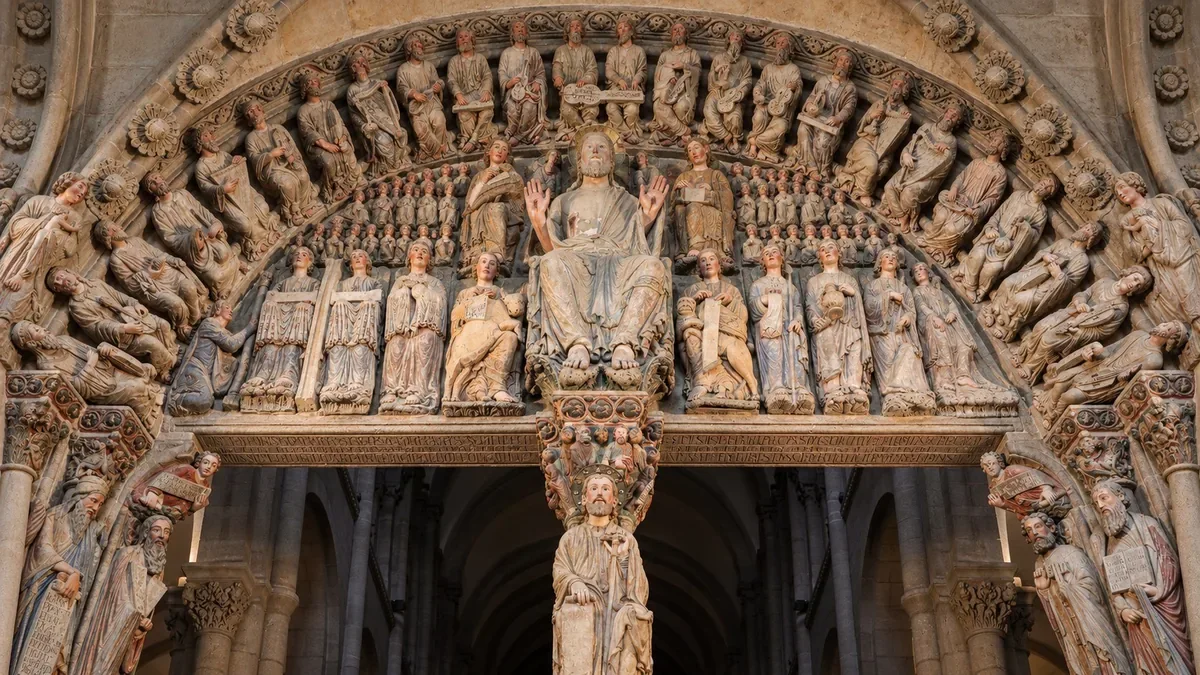
The Portico has three arches, one for each nave of the church. In the central arch, Christ in Majesty shows the wounds of the Passion, surrounded by the four Evangelists and by angels carrying the instruments of his martyrdom. On the central column, the trumeau, a seated Saint James welcomes pilgrims, above a Tree of Jesse tracing Christ’s lineage. The side columns hold the apostles and prophets. Among them, Daniel smiles: one of the best-loved figures in Romanesque sculpture. The side arches represent the Old Testament and the Last Judgement.
Originally, the Portico was the cathedral’s outer façade, and it was painted. In the eighteenth century it was enclosed behind the Baroque Obradoiro façade, which sheltered it from the weather and turned it into an entrance hall.
The stone musicians
The twenty-four Elders of the Apocalypse sit around the central arch. Each holds a musical instrument, and many seem to be chatting as they tune it. There are fiddles, harps, psalteries and lutes, and at the centre an organistrum, a kind of large hurdy-gurdy played by two elders at once.
The instruments are carved in such detail that they are one of the most important sources for medieval music. Researchers and instrument makers have used them as models to rebuild instruments that no longer existed. For an association with music at the heart of its work, this stone choir is a constant reference.
The Santo dos Croques
Behind the trumeau, facing the altar, kneels a small figure. Tradition holds that it is a self-portrait of Master Mateo. For generations, students knocked their heads against it (croques in Galician) hoping some of his talent would rub off on them. Historians still debate whether the figure really is the master, but the tradition has stayed.
It was also customary to place a hand on the Tree of Jesse on the trumeau. After centuries of pilgrims, their fingers had worn hollows into the stone. Today both figures are protected and can no longer be touched.
The restoration
Between 2008 and 2018 the Portico underwent a thorough restoration. The work cleared away centuries of dirt and damp and recovered part of the original paint, which lets us imagine how the first pilgrims saw it: a portico full of colour, far more vivid than we had thought.
Why his name
Master Mateo led a workshop in which stonemasons, sculptors, painters and master builders worked side by side. His work brings together architecture, sculpture and music, and it has been welcoming people from all over the world for more than eight centuries. For an association working with heritage, music and publishing, he is a good model.
You can read more about him in his entry in the Compendium of Galician culture, and about the cathedral in the Sacred heritage route.