O carro e o home: the life of the Galician farmer at the pace of the oxen
A film shot over ten days in the summer of 1940 in Lobeira tells the life story of a Galician ox cart, from the oak tree to the barn. Around it, the culture of the farmer: shared work, the singing axle and a world that has vanished.
The video loads from YouTube when you press Play.Watch on YouTube
Chapters
For centuries, almost everything the land gave in Galicia travelled on a cart: gorse and manure, grass and straw, rye and potatoes, firewood, stone and wine. Drawn by a pair of cows or oxen, the carro do país, the country cart, set the rhythm of work, measured the roads and filled the sunken lanes with an unmistakable sound. A twelve-minute film, O carro e o home (“The Cart and the Man”), shot in 1940 by the filmmaker Antonio Román with the ethnographer Xaquín Lorenzo, known as “Xocas”, tells its life as if it were a person’s. It is also one of the great documents of Galician peasant culture.
A film made in ten days
In 1939, Xaquín Lorenzo and Antonio Román, both from Ourense, agreed to make an ethnographic documentary about the cart; its working title was Biografía del carro. They shot it over ten days in the summer of 1940 in Lobeira, in the Baixa Limia, around Facós, the village where Xocas had spent long stretches at his grandmother’s house. With them was Carlos Serrano de Osma, assistant director and collaborator. The actors were not actors: they were Xocas’s neighbours and friends, doing in front of the camera what they did every day.
The film’s own story is almost as eventful as the cart’s. Román sent the work print to Xaquín Lorenzo, who kept it at the Museum of Ourense, and for years it was believed to be all that survived. In 1945 Serrano de Osma submitted a version to the censors on behalf of the production company PACE, with Galician folk music and a more neutral voice-over. In 1980 the filmmaker Eloy Lozano recovered that work print and, with the Museo do Pobo Galego, made the version we know today: he kept the original editing and added classical music and the voice of Xocas himself, who wrote and read the narration. The Filmoteca de Galicia has digitised it in 4K from the 35 mm materials in its collection.
The life story of a cart
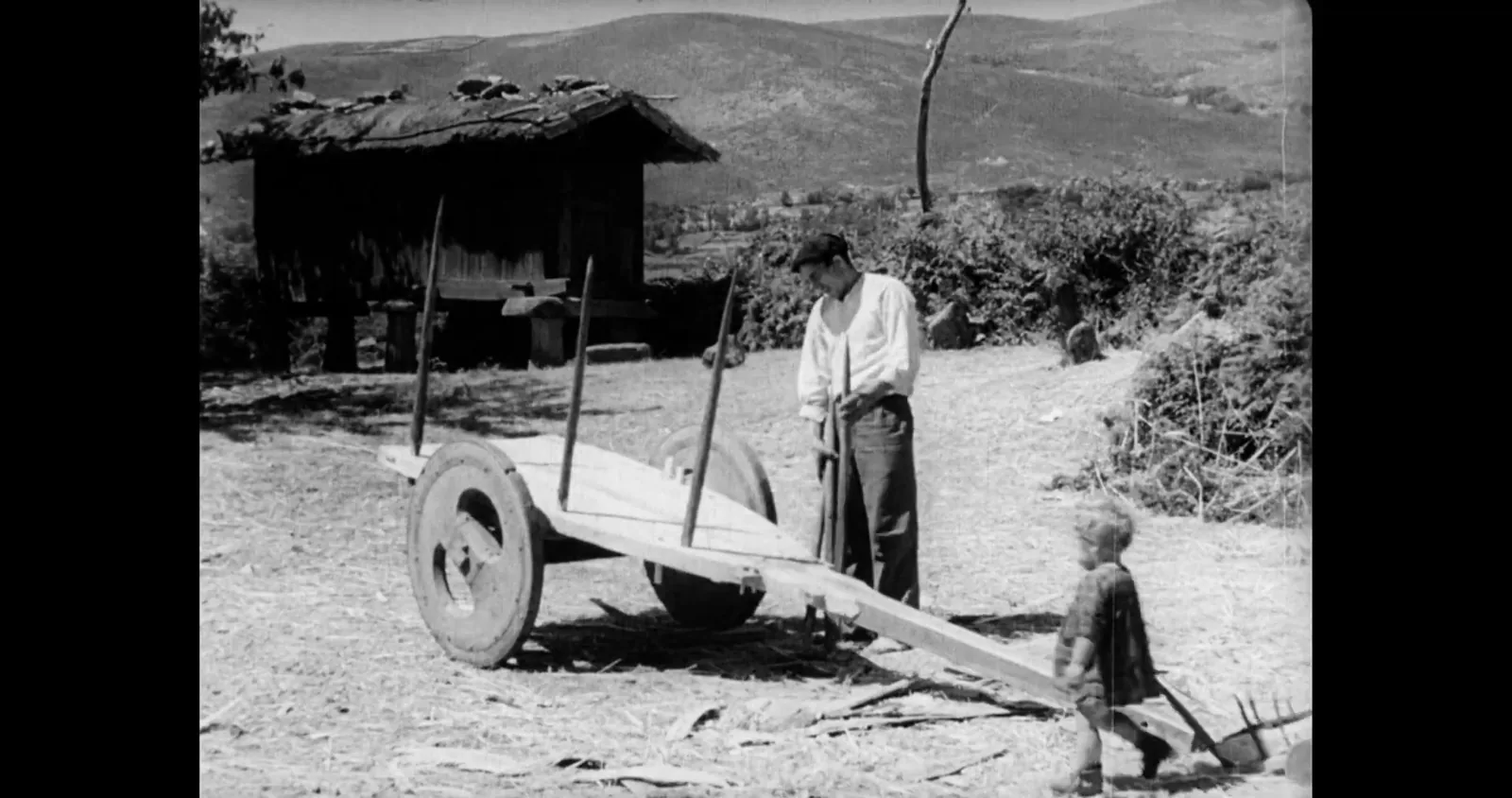
The film follows the cart from before it is born. The men climb the hill with their axes and choose the oak; the timber comes down to the village and the carpenter, in the farmyard, shapes the chedeiro (the cart bed), the axle and the wheels, piece by piece, with adze, saw and gouge. When the cart is finished comes the yoking: the cows, the yoke, the pin. And a working life begins that is the life of the household itself.
Anatomy of the country cart
The Galician cart is a wooden machine of great ingenuity. It has two parts that can be separated: the chedeiro, the bed that carries the load, and the rodado, the axle with its two wheels. The master piece of the bed is the cabezalla, an oak beam that runs from back to front and extends forward to the yoke; the chedas form the sides and, in many districts, close towards the front like a prow, the so-called ogival bed. On top run the tesoiros, the crossbars, and along the edges stand the fueiros, the stakes that hold the load.
What makes it unique is the running gear: the eixe, the axle, is fixed to the wheels and turns with them, as in the Roman plaustrum, of which the Galician cart is a direct descendant. Each wheel is solid and made of three main pieces: the mión, the central board into which the axle fits, and the two side cambas, joined by relas (cross-bars) and bound by an iron tyre, the baldón. The openings between the cambas and the mión lightened the wheel. The axle turns held between the treitoiras, which fix it beneath the bed. The woods were chosen with care: oak for the beam, the sides and the wheels; ash or alder for the axle; willow, box or birch for the smaller parts.
It is no recent invention. The Pedra Alta stela at Castrelo do Val (Ourense), dated between 1200 and 1000 BC, already shows a cart: the first documented in Galicia.
The song of the cart
The Galician cart sings. The friction of the axle against the treitoiras produces a long, high-pitched squeal that could be heard for miles, and which was a source of pride for the farmer: a cart that sang well was a loaded cart, and every carter knew his own. To tune it, the treitoiras were tightened or loosened, or the axle was soaked in the river; folk songs argue over which wood makes it sing best, oak, ash, alder or birch. The song also had a practical purpose: it gave warning in the narrow lanes where two carts could not pass, and it kept the oxen moving.
To foreign travellers such as George Borrow or Dembowski the squeal was unbearable. The English Hispanist Aubrey F. G. Bell reported that, when passing through towns, country people were required by law to silence the wheels with soap.
The farmer’s year
In the film the cart is the thread, but the subject is the farmer and his year. We see the rye harvest, the sheaves piled high, and the malla, the threshing on the threshing floor, to the steady beat of the flails: work done in common, with the neighbours’ help, and ending in a feast. We see the cart on the hillside, gathering gorse and scrub that would become bedding for the animals and then manure for the fields, in a cycle where nothing was wasted. And we see flax: the women scutching it, spinning it and weaving it on the household loom, the other half of peasant work, the half that almost never appeared in photographs.
The world Xocas portrays was one of interdependence: house, land, common hillside and livestock formed a single system, and the village worked as a community of labour. The cart, built with the neighbours and serving the household for generations, was its emblem.
The end of a world
The film ends like a life: the axle breaks, the cart is no longer useful, and the bed ends up hanging on the wall, old and empty. In the decades that followed, the scene was repeated all over Galicia: first came the carretón, then the tractor. What remains of the country cart are memories, museums and a few festivals, such as the Folión de Carros in Chantada, which every year, on the night before the fourth Sunday in August, fills the streets with carts turned into stages for scenes of traditional life. It has been a Festival of Tourist Interest of Galicia since 2002 and was declared an Asset of Cultural Interest in 2019.
Xaquín Lorenzo, “Xocas”
Xaquín Lorenzo Fernández (Ourense, 1907 – Lobeira, 1989) was an ethnographer, archaeologist and teacher, a member of the Seminario de Estudos Galegos and close to the Nós Group of Risco, Otero Pedrayo and Cuevillas. He travelled Galicia for more than twenty years to write Etnografía. Cultura material, the volume of the Historia de Galiza edited by Otero Pedrayo (1962), and devoted essential studies to the cart. He was one of the founders of the Museo do Pobo Galego, created in 1976, and later its president. The Royal Galician Academy dedicated the 2004 Galician Literature Day to him. Antonio Román (Ourense, 1911 – 1989) went on to a long career in Spanish cinema, with films such as Los últimos de Filipinas; O carro e o home is nonetheless his work closest to the land.
Credits
O carro e o home · Director: Antonio Román · Screenplay: Xaquín Lorenzo and Antonio Román · Assistant director and collaborator: Carlos Serrano de Osma · Editing: Antonio Román and Carlos Serrano de Osma · Narrator: Xaquín Lorenzo · Shot in Lobeira (Ourense), summer 1940 · Sound version: 1980 (Eloy Lozano, with the Museo do Pobo Galego) · Black and white, 12 min. Original version in Galician.
4K digitisation by the Filmoteca de Galicia (Axencia Galega das Industrias Culturais, Xunta de Galicia) from the 35 mm materials in its collection, co-funded by the European Union through the ERDF. The video plays from YouTube; all rights belong to their holders. The images in this article are frames from the film, reproduced as quotations for commentary and analysis. The drawing of the cart’s anatomy is an original work by the Asociación Cultural Mestre Mateo.
Sources: Filmoteca de Galicia, O carro e o home film record; Deputación de Pontevedra, “Letras Galegas: Xaquín Lorenzo”; Museo da Limia, “Xaquín Lorenzo Fernández (Xocas)”; Play-Doc, Tony Román retrospective; tecnoloxia.com, “O carro galego”; Sociedade Columba, “O carro do país”; Amigos do Folión, “Carro: o orgullo”.