The Portico of Glory, arch by arch
More than two hundred figures carved in granite and marble tell the story of salvation, from the Old Testament to the Last Judgement. A guide to reading the Portico.
The Portico of Glory is the western entrance to the Romanesque cathedral of Santiago. Master Mateo directed it from its foundations, and on 1 April 1188 he set the lintels in place, as the inscription he carved on them records. It has more than two hundred figures and is one of the great works of medieval European sculpture.
To read it, imagine a pilgrim reaching the end of the road. The Portico tells them the whole story of salvation, from left to right and from bottom to top: from the people of Israel to the heavenly Jerusalem.
A work on three levels
The Portico is not just a façade. Mateo built three levels, one above the other:
- The crypt, which levels the sloping ground. Its vault bosses show the earthly world, lit by the sun and the moon.
- The portico itself, with its three arches, one for each nave of the church.
- The gallery, where the vault boss bears the Lamb, the light of the new Jerusalem.
The column bases show real and fantastic animals taken from medieval bestiaries. They stand for evil, crushed under the weight of God’s glory.
The left arch: waiting
The left arch is devoted to the people of Israel and the Old Testament. Above, Christ descends into limbo to free the righteous who had been awaiting him. On the columns, the prophets hold scrolls bearing their prophecies. Among them is Daniel, smiling. His smile, so natural it hardly seems to be stone, is one of the best-known images of the Portico.
The central arch: glory
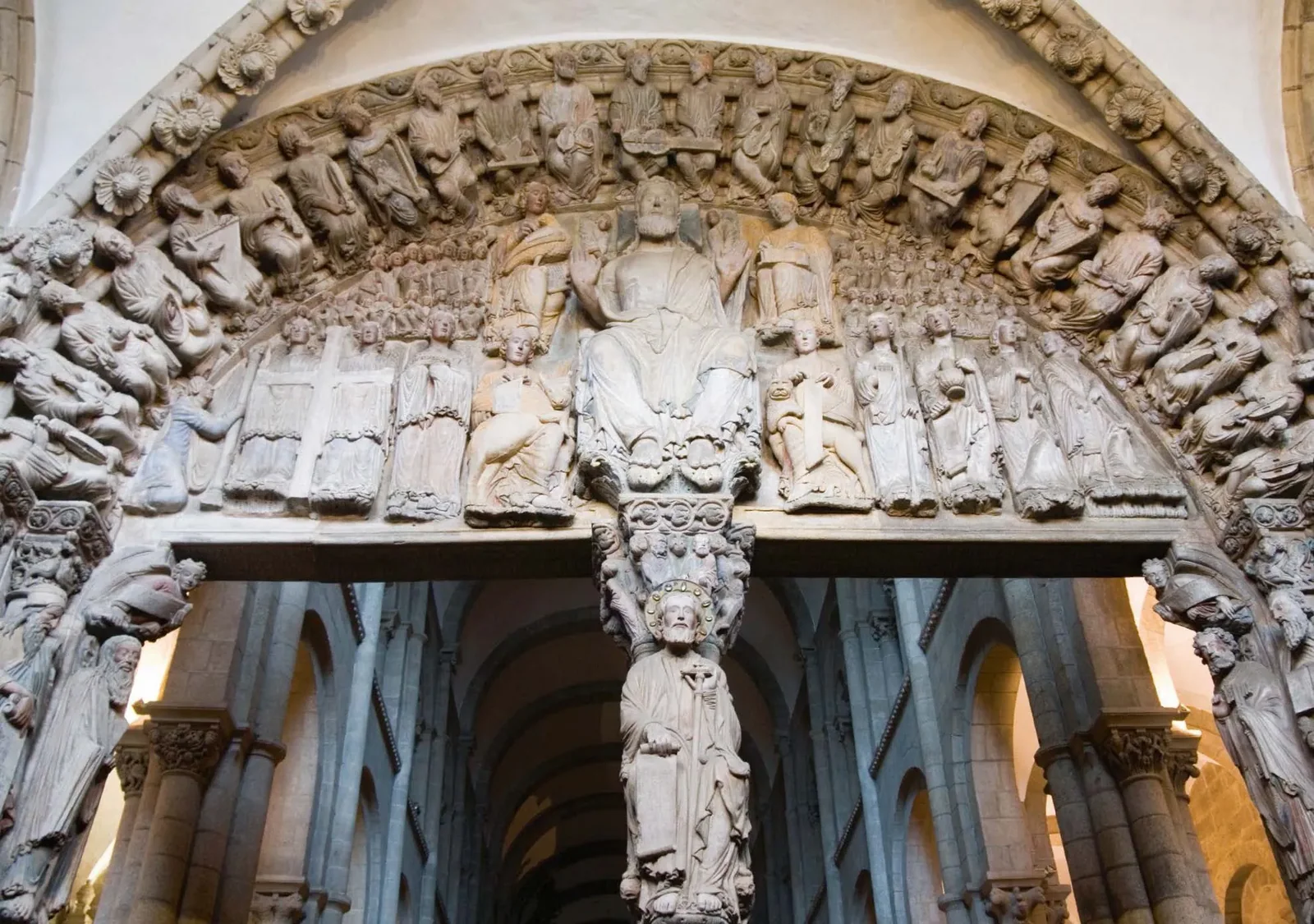
In the central tympanum, Christ in Majesty shows the wounds of the Passion. Around him are the four Evangelists with their symbols: John with the eagle, Mark with the lion, Luke with the ox, and Matthew seated on a chest, a reminder of his trade as a tax collector. Robed angels carry the instruments of the martyrdom: the cross, the crown of thorns, the nails, the lance. Behind them, in miniature, a crowd represents the blessed.
On the archivolt sit the twenty-four Elders of the Apocalypse with their musical instruments. They have an entry of their own.
On the trumeau, the column dividing the doorway, a seated Saint James welcomes the pilgrims. Below him is a Tree of Jesse tracing Christ’s lineage, and at its base, facing the altar, the Santo dos Croques.
The right arch: judgement
The right arch represents the Last Judgement. On one side, angels carry the souls of the saved to heaven. On the other, demons torment the damned: a glutton tries to eat while a snake squeezes his throat, and the greedy have their hands and feet bound. The columns on this side hold the apostles, among them a very young John.
The lost colours
The Portico was painted. The restoration carried out between 2008 and 2018, funded by the Fundación Barrié, found traces of up to three complete layers of paint, as well as partial repainting from the original workshop through to the Baroque. The work also solved problems of damp and condensation that were damaging the stone.
Since then, visits have been made in small groups to keep humidity and temperature stable. The trumeau, where the hands of millions of pilgrims had worn the imprint of their fingers, can no longer be touched.
Further reading
Santiago Cathedral: the Portico of Glory · Santiago Turismo: the Portico of Glory · A. García Omedes: Catedral de Santiago de Compostela, in La guía digital del arte románico