Tools of the Galician farmer: a year's work by hand
A field notebook from the Navia valley keeps the names of the tools that worked Galician land until half a century ago. We follow them through the farming year, from the plough to the granary.
For centuries, the Galician labrego worked the land with tools that he himself, or the parish smith and carpenter, made and mended. Oak, ash or chestnut wood; iron beaten at the forge; willow and split chestnut for the baskets. With these the land was ploughed, dug, mown and threshed, and the year’s bread was stored until the next.
Many of these tools had barely changed since Antiquity. The wooden ard still used in mountain fields in the mid-twentieth century was a direct relative of the Roman plough. The scythe, the sickle and the flail had the same shape seen on medieval capitals and farming calendars. And yet, within a single generation (between the 1950s and the 1980s) almost all of them vanished from daily work, ending up in the attic, the ethnographic museum or on the wall of a rural guesthouse.
This feature follows the farmer’s year through fifteen plates made from a hand-drawn field notebook. The notebook records not only the shape of each tool but also the name of each of its parts, and the variants those names took from parish to parish. We keep them in Galician, because they are the heritage the notebook set out to save.
A vocabulary that fits in a notebook
The original notebook has handwritten lettering, arrows, underlined names and, in brackets, the place where each variant was collected. The plates in this feature redraw it and number the parts, with the names and their variants below. The place names (Freixo, Barangón, Carballido, Cereixido, San Mamede, San Pedro de Río, Negueira, Vilardiaz, Arroxo, Brancio, Lamas…) take us to the uplands of the river Navia, in the east of the province of Lugo, where mountain farming kept its traditional tools until very late.
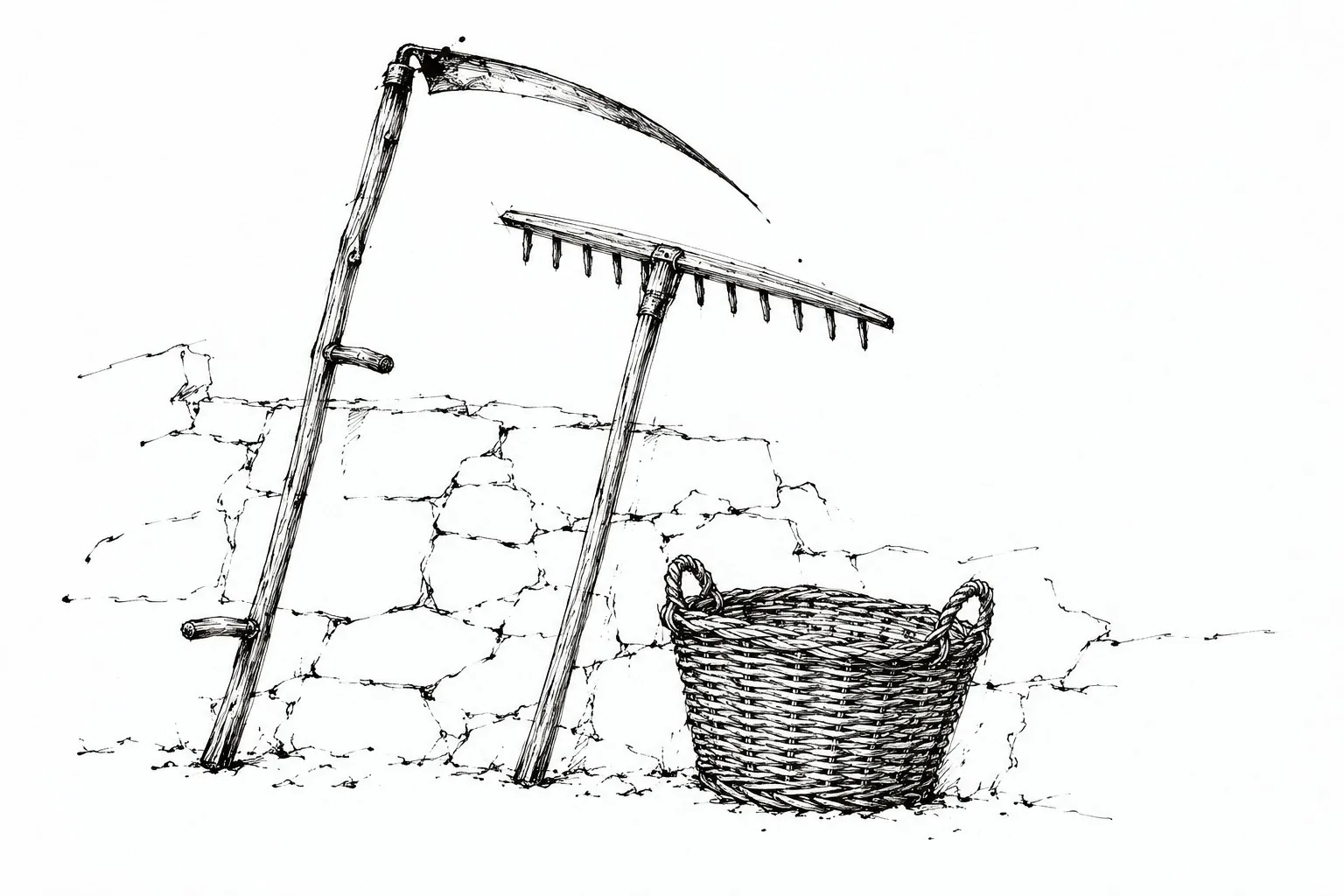
That is where the notebook’s value lies. What a dictionary gives as a single word was, in the village, a small linguistic map. The hay rake, the angazo, is engazo in Freixo and Barangón, arrestelo in San Mamede and runqueiro along the river Navia. The scythe is held by its muletas in Brancio, its afincadoiros in Cereixido, its gardamaus in Arroxo, its manillas in Carballido and its asas in Barangón. Every village had its own way of naming things, and all of them were right.
Opening the soil: plough and harrow
The year began with the soil. The arado de pau (wooden ard), also called aradín (Freixo) or arado de madeira (Negueira), was made entirely of wood except for its tip. The farmer guided it by the rabela (handle); the long lata (beam) joined the plough to the yoke; the teiriña (brace) held it and set the depth, and at the front was the rella (share), the iron piece, fitted onto the palmela (sole). The orelleiras or orellas opened the furrow to either side. At the end of the beam, the figaro, chavilla, chavella or pecho (depending on the place) pinned it to the yoke.
Beside it, the plate shows the cambela, a curved body (the camba) bound to the beam with the apreixos or apreixadoiros. Stony, steep mountain land called for light tools that could be lifted and repaired without a smith.
After ploughing came the grade (harrow), which broke up the clods and levelled the field. The wooden one was a frame of traveseiros (cross-beams) studded with dentes (spikes), dragged by the rabela or temón. The iron one, more modern, already had agarradoiras (handles), a roda (wheel) and even a depth control: an early sign of how industry was entering village work, piece by piece.
The yoke: the strength of the herd
None of this moved without the animals. The xugo (yoke) for cattle was a carved wooden beam with its castelos and cantrelas, tied to the animals with sogas (straps) and mulidas, the pads that protected their foreheads. In the centre, the dobla, tuxeiro or tallobre received the pole of the cart or the plough. Mules and horses used another system, with cuelleiras and a collarón. The plate also shows a mixed yoke, for a cow and a mule, a sign of humble households that yoked whatever they had. It is the same yoke that, in our feature O carro e o home, made the cart’s axle sing along the roads.
Digging and clearing: tools of the hand
Where the plough could not reach, the arm did. The family of the aixada (hoe) is huge and each village has its own name for it: axada (Arroxo), xada (Cereixido), anxada (Freixo). It had a pala or folla (blade) and an ollo (eye) for the handle. The aixadón (mattock) was its heavy version, for deep digging. The rodo (legón in Negueira) dragged soil; the chapo (sacho in Vilardiaz) weeded maize and potatoes; the toothed gadañón broke up clods.
The same plate shows a humble, ingenious machine: the máquina de picar o toxo (gorse-chopping machine), a table with a curved coitela (blade) worked by a mango (crank). Chopped gorse was bedding for the animals and then manure for the fields: the hillside fed the farmland.
The hillside had its own kit: the pico (pick), with the peta (adze) on the other side; the podón de monte (billhook; podoa in Negueira) and the fouce do toxo; the long-handled fouce, with its rabizo; and the rozón (brush hook), which is gadaño in Freixo, gadañón in Carballido, fouzón in San Mamede and fouza in Barangón.
Winter: wood
The cold months were for firewood and carpentry. The brosa (axe; broso if small), the marra (sledgehammer; maza in Freixo), the mazuco (mallet; malluco in San Pedro de Río) and the cuñas (wedges) split the logs. The tronzador (crosscut saw) was worked by two people, by its asas or manillas; the serra de aire and the serra portuguesa cut planks, and the pau-ferro served as a crowbar. That wood later became handles, yokes and carts.
Hay: the scythe and the ring of the anvil
Summer brought the hay harvest, and with it the farmer’s most elegant tool: the gadaña (scythe). On the estil, mango or rabo (snath), the grips (which, as we saw, changed name from village to village) allowed the long sweeping swing that mowed the meadow. The folla (blade; verduguillo in Vilardiaz) was joined to the snath by the calcaño (heel) and the argola (ring), and ended in the fío or corte (edge).
A scythe lost its edge quickly, and sharpening it was a ritual. In the meadow itself the incre, a small pointed anvil, was driven into the ground, and the blade was hammered on it with the martelo de crabuñar (peening hammer): the steady metallic beat of crabuñar was one of the sounds of a village summer. At home there was a fixed anvil, set in a cepo (block). Between swathes the mower used the pedra de afiar (whetstone), which he carried at his belt in the corno, a cow horn filled with water, hung by its gancho (hook).
Bread: sickle, flail and threshing floor
Rye and wheat were cut with the fouzo (sickle; fouciño in Negueira), with its curved blade and short handle. Then, on the threshing floor, came the malla: the malle (flail) was a long staff (the mango, moca or pértega) joined by a leather xugo to the short stick that beat the ears. Each part, once again, had its local names. Threshing was neighbourly work: families helped one another in turn, and the day ended with food and celebration.
With the grain on the ground, the vasoira and the cuañeira (brooms) swept away straw and chaff; the round cribo and the large criba cleaned the grain. Straw was tied with biortas, twisted willow withies (birta in Freixo).
The machine reaches the threshing floor
During the twentieth century, máquinas de mallar (threshing machines) gradually reached the parishes. They were driven first by hand or by a horse gin, and later by an engine. The plate shows one from outside (the tableiro, the rodas, the timón, the pulley carrete) and from inside, with the cilindro de degrañar (threshing drum) and the tragante da palla or cebador (feeder). Where there had been a whole day of flail blows, there was now the roar of the engine and the dust; the threshing feast changed its sound but stayed communal.
With it came the limpadora, a hand-cranked winnower: the grain fell from the muxega (hopper), the pelas or aspas (fan blades) turned in the bombo do aire (fan drum), and the cribas (sieves) separated good grain from small grain and dirt, each through its own outlet. The wind of the threshing floor, once awaited with arms held high, had been shut inside a wooden box.
Measuring, carrying, storing
Clean grain was measured with the tego, a trough-shaped wooden measure, and carried in the caldeiro (bucket) and the cesta (basket). It was stored in the house’s paneira or hucha (grain chest), or in the tuñas of the hórreo, the granary raised on stone legs to keep out damp and rats. On that grain depended the whole year’s bread and the next year’s seed.
Rake, forks and pitchfork
To gather and move hay and straw there was a whole family of toothed tools. The wooden angazo (rake: engazo, arrestelo, runqueiro), with its lombo (head) and dentes (teeth). The forquito, which in other villages is forcada, and in San Pedro de Río forquita or galla: sometimes just a forked branch. The galleira, with two iron tines. And the horca (pitchfork; culmeira in Barangón, forqueta in Vilardiaz), with its ollo (socket) and dentes, for manure and heavy hay.
Baskets: the architecture of willow
No farm work made sense without the basket maker. Each basket had its trade: the cesto da semente for seed potatoes; the cesto das castañas for chestnuts; the cestos or bozos fitted over the muzzles of cows and calves so they would not eat the crop; the esporta or espuerta; the large canasto.
Among the baskets without handles were the cesta that took lunch out to the field, the peselo (for chestnut burrs, turnips and potatoes), the banastra for carrying baked bread (in which, the notebook says, babies were also laid to sleep) and the cesto de tablas, a board tray for sowing grain and spreading chemical fertiliser. That last detail is a reminder that, when the notebook was made, the old world and the new already shared the same field.
The end of a world
From the 1950s on, emigration emptied the villages, land consolidation redrew the fields and the tractor replaced the yoke of cows. Within one generation, the knowledge these plates record (how to peen a scythe, how to yoke two cows, what the piece that holds the share is called) stopped passing from parents to children.
The tools remain, often hung on a wall as decoration. And the names remain, the most fragile part of this heritage. That is why the notebook matters so much: it gathered the words while there were still people who spoke them.
Further reading
Museo do Pobo Galego (Santiago de Compostela); Xaquín Lorenzo, «Etnografía. Cultura material», in Historia de Galiza, ed. Ramón Otero Pedrayo (1962).