
O Castro de Samoedo
Sada, A Coruña
- Place
- Sada, A Coruña
O Castro de Samoedo became a physical laboratory of modern Galician culture: factory, museum, publishing, design, archive and thought coexisted within one complex.
In the late 1940s Isaac Díaz Pardo began ceramic experiments at O Castro de Samoedo that would lead to Cerámicas do Castro. The place was conceived from the outset as more than a factory: production, design and experimentation were to belong to a single process.
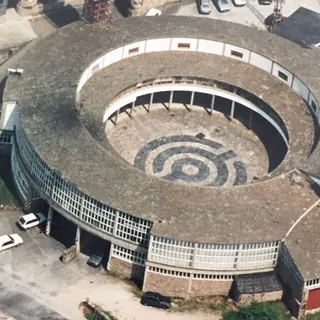
With the Laboratorio de Formas, O Castro became a centre within a wider institutional network. Ediciós do Castro, the Museo Carlos Maside and activities of seminar, exhibition, archive and cultural debate all operated here. Architecture itself formed part of the identity of the complex.
The concentration of cultural functions in one place expresses a characteristic idea of Díaz Pardo and Seoane: culture should not be separated from economic production or daily life, but should build durable structures capable of preserving memory and creating new forms.
Factory and culture
Ceramic production coexists with and supports museum, publishing and research activity.
Architecture as identity
Buildings, circulation and furniture belong to a global cultural design, not merely an industrial site.
Institutional memory
O Castro preserves the material trace of a network that sought to rebuild cultural continuity broken by war and dictatorship.
- finais anos 1940Díaz Pardo begins ceramic experiments at O Castro
- 1950Commercial production begins at Cerámicas do Castro
- 1970The Museo Carlos Maside opens provisionally
- 1982The Museo Carlos Maside moves into its permanent building

- Isaac Díaz Pardo · Álbum de GaliciaConsello da Cultura Galega
- Isaac Díaz Pardo · Álbum de GaliciaConsello da Cultura Galega
- Museo Carlos MasideIsaac Díaz Pardo · arquivo dixital
- Museo Galego de Arte Contemporánea Carlos MasideMuseos de Galicia · Xunta de Galicia